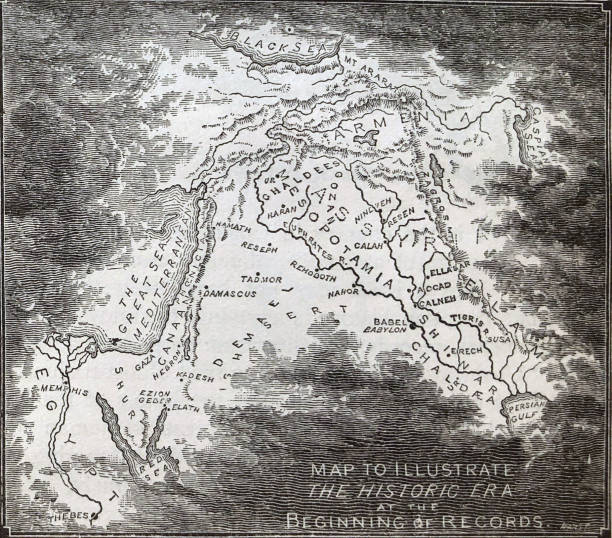
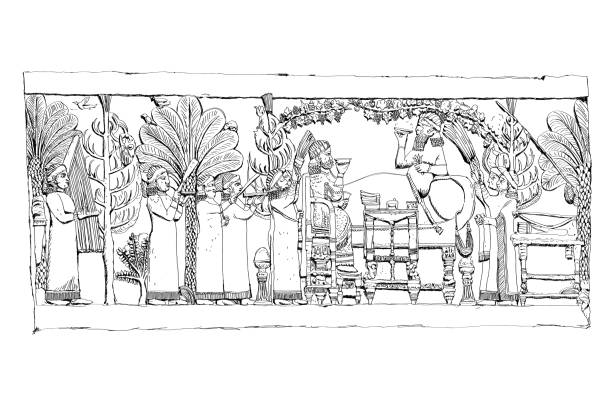
Illustration from 19th century.
Browse 230+ drawing of a mesopotamia stock illustrations and vector graphics available royalty-free, or start a new search to explore more great stock images and vector art.
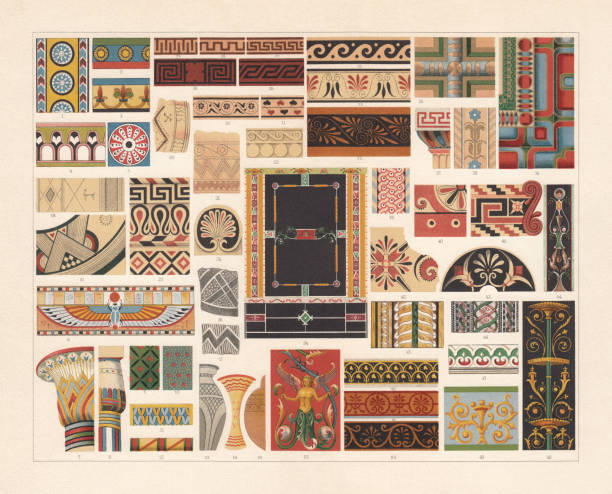
Various patterns of antiquity: 1-5 Assyrian: 1) Nimrud; 2) Nineveh; 3 - 5) Dur Šarrukin (Khorsabad). 6 - 15 Egyptian: 6) Ornament of a mummy coffin; 7) Bell-shaped capital; 8) Bud capital; 9 - 10) Textile ornaments; 11) Quiver ornament; 12) Painted stick; 13 - 15) Pottery. 16-17: Ceramic shards from Troy. 18 - 19: Cypriot clay pots. 20 - 39 Greek: 20 - 21) Ceramic shards from Mycenae; 22) Architectural ornament (Mycenae); 23) Cornice (Olympia); 24) Antefix (Olympia); 25 - 29) Meander ornaments of vases; 30 - 31) Leaf and plant ornaments; 32 - 34) Palmette ornaments of vases; 35 - 36) Ceiling of the Theseus temple (Athens); 37) Doric capital (Parthenon); 38 - 39) Wall painting. 40 - 43 Etruscan: 40) Stucco painting; 41 - 42) Wall painting; 43) Antefix. 44 - 54 Roman: 44 + 49) Wall painting; 45 - 46) Mosaic; 47) Stucco painting; 48) Pompeian wall painting; 50 - 52) Pompeian frieze painting; 53) Painted relief from Pompeii; 54) Wall painting of a dining room in Pompeii. Chromolithograph, published in 1897.

Hand drawn vector illustration of date palm tree. Ink sketch isolated on white background. Retro style.
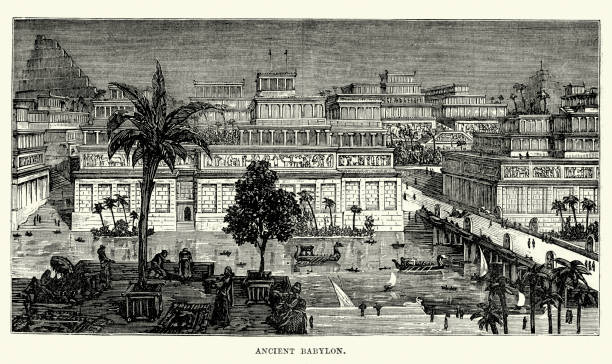
Vintage engraving of Ancient Babylon. Babylon (Akkadian: Babili or Babilim; Arabic: Babil) was a significant city in ancient Mesopotamia, in the fertile plain between the Tigris and Euphrates rivers.
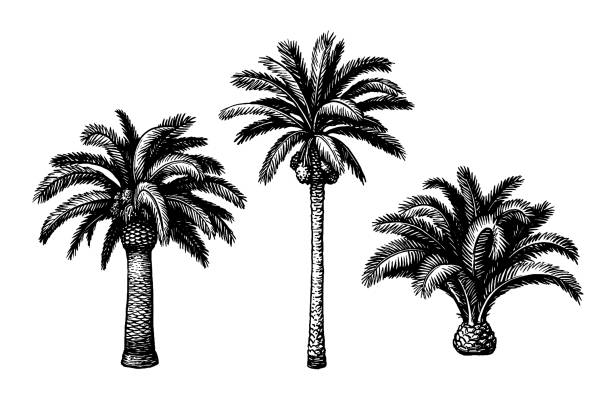
Hand drawn vector illustration of date palm trees. Ink sketch isolated on white background. Retro style.
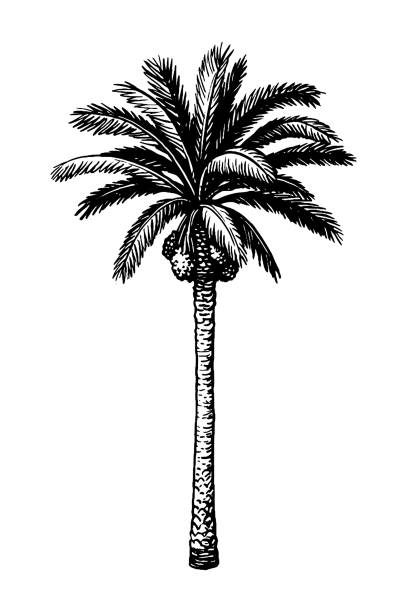
Hand drawn vector illustration of date palm tree. Ink sketch isolated on white background. Retro style.

Sennacherib meaning "Sîn has replaced the brothers") was the king of the Neo-Assyrian Empire from the death of his father Sargon II in 705 BC to his own death in 681 BC. The second king of the Sargonid dynasty, Sennacherib is one of the most famous Assyrian kings for the role he plays in the Hebrew Bible, which describes his campaign in the Levant. Original edition from my own archives Source : Bilder-Atlas - Ikonographische Encyklopädie 1870

Elements of ancient fine arts of peoples of the world vector background

Marketplace with Grand Mosque Ahmet-Khiaia in BaghdadOriginal edition from my own archivesSource : Tour du monde 1861Drawing : M.E. Flandin

Assyrian portal of city Khorsabad ( Ninive ) - Dur-Sharrukin ( Fortress of Sargon ), present day Khorsabad, was the Assyrian capital in the time of Sargon II of Assyria.A human-headed winged bull known as a lamassu - ( Sumerian protective deity )Original edition from my own archivesSource : Correo de Ultramar 1874

Marketplace with Grand Mosque Imam-Moussa in BaghdadOriginal edition from my own archivesSource : Tour du monde 1861Drawing : M.E. Flandin - C. Maurand

Assyrian warriors with their booty. Wood engraving after an Assyrian bas-relief, published in 1862.

Ancien world : Assyrian chariot with warriors. Vintage engraving circal late 19th century. Digital restoration by Pictore.
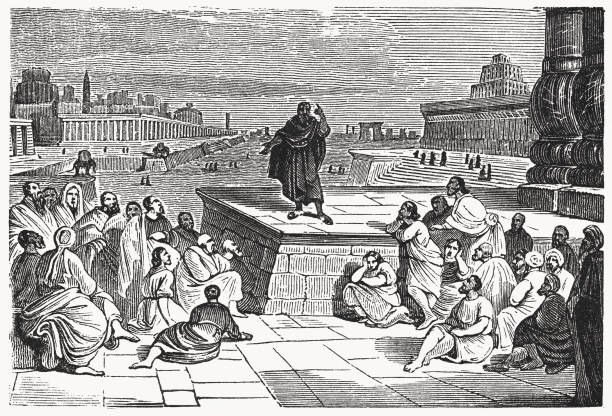
Jonah Preaching to the Ninevites (Jonah 3). Wood engraving, published in 1835.

Sumerian temple - Scanned 1882 Engraving

Vintage engraving Ancient tablet containing the Chaldean account of the deluge or great flood

blueprint of the Great ziggurat of Ur aka Ur-Nammu Dhi Qar, Iraq

Tower of Babel. Ancient city Babylon of Mesopotamia and Iraq. Biblical story. Sumerian civilization. History and archaeology. Hand drawn sketch isolated on white

An engraved illustration image of Alexander the Great cutting the Gordian Knot, from a vintage Victorian book dated 1850 that is no longer in copyright

Assyrian king - Neo-Assyrian, Sargonid Dynasty - ca. 721-705 BCEOriginal edition from my own archivesSource : Correo de Ultramar 1874

Assyrian goddess before the sacred tree - Scanned 1882 Engraving

Daniel and his friends before King Nebuchadnezzar (Daniel 1). Wood engraving, published in 1862.

Tomb of sheik Omar in BaghdadOriginal edition from my own archivesSource : Tour du monde 1861Drawing : M.E. Flandin - C. Maurand

Astarte - ancient goddess of fertility, sex, love and war of several West Semitic peoples. Wood engraving, published in 1893.

Steel engraving This bas-relief from Khorsabad showing an eagle-headed genie. Bird-headed Genie from the Palace of Sargon II at Khorsabad - Neo-Assyrian, Sargonid Dynasty - ca. 721-705 BCEOriginal edition from my own archivesSource : "Calwer Bibellexikon" 1885

Chaldeans working at assyrian portal of city Khorsabad the Assyrian capital in the time of Sargon II of Assyria.Chaldeans are members of an ancient Semitic people who ruled in BabyloniaOriginal edition from my own archivesSource : Tour du monde 1861Drawing : M. Régis after M.E. Flandin

A Cedar Forest in rural Lebanon, drawing by James Duffield Harding. Vintage etching circa 19th century.

Black Alien vector design of ancient Babylon and Sumerian deity on white background

Mosul is a major city in northern Iraq. Located approximately 400 km (250 mi) north of Baghdad, and 170 km southeast of the city of Cizre in Turkey, Mosul stands on the west bank of the Tigris, opposite the ancient Assyrian city of Nineveh on the east bank.Original edition from my own archivesSource : Tour du monde 1861Drawing : M.E. Flandin - C. Maurand

Map of Near, Middle and Far East Asia with distances from London. "Royal Geographical Readers no. 5" of Asia, Africa, America & Oceania, publ. T Nelson & Sons, London, 1883.

Black Babel tower bible story icon isolated on white background. Set icons colorful. Vector.

Assyrian chariot. Wood engraving after an ancient bas-relief, published in 1862.

Young Tobit and the Fish (Book of Tobit 6). Wood engraving, published in 1835.

Historical view of the plain of Babylon, Iraq. Wood engraving, published in 1862.

Assyrian king. Wood engraving after an ancient bas relief, published in 1862.

The lamentations of the Israelites during the Babylonian exile (Psalms 137). Wood engraving, published in 1835.

People of Hebrew on the left - old jewish carriageThe modern English word "Hebrew" is derived from Old French Ebrau, via Latin from the Greek and Aramaic all ultimately derived from Biblical Hebrew Ivri one of several names for the Israelite ( Jewish and Samaritan ) people ( Hebrews ).Original edition from my own archivesSource : Bilder-Atlas - Ikonographische Encyklopädie 1870

Vintage illustration View on the shores of the Tigris river, Victorian 19th Century 1870s. Jouneyings in Mesopotamia, by Lieutenant C R Low

Vintage engraving of the Battle of Carchemish, fought about 605 BC between the allied armies of Egypt and former Assyria against Babylonia.

Jonah's resentment at God's mercy (Jonah 4). Wood engraving, published in 1835.

Dagon, the Fish-God - a deity worshiped in Mesopotamia and Syria. It was the main god of the Philistines. Wood engrafing after the 'Oannes' Relief in Khorsabad (Dur-Sharrukin, Assyria), published in 1862.

Architecture of Mesopotamia: 1) Assyrian warriors on horseback; 2) Assyrian warriors with chariots; 3) Lion hunt; 4) Bull hunting; 5) Siege of a city; 6) Conquest of a fortress, deportation of the prisoners; 7) Assyrian king Sardanapalus in his chariot; 8) Activities at sea; 9) Assyrian king Ashurbanipal (reig. 668-626 BC) and his queen in his royal garden (Nineveh, Iraq); 10) Victoriously returning Assyrian king; 11) Horse head (Nineveh); 12) Bronze lion (Nineveh); 13) Blessing genius (winged man, Nineveh); 14) Sargon II (right) and a dignitary. Sargon II's palace at Dur-Sharrukin, c. 716 - 713 BC, bas-relief, exhibited at the Louvre; 15) cylinder with cuneiform scripts; 16) Shalmaneser III (reign. 860 BC - 825) and Israel (black limestone obelisk, 841 BC, Nimrud); 17) Mosaic ornament; 18) Visual reconstruction of the northern part of the palace of Dur Sharrukin (Khorsabad, Iraq). Wood engravings, published in 1893.

Scujlpture representing the victory of Sardanapalus - Scanned 1890 Engraving

Paper cut Babel tower bible story icon isolated on grey background. Paper art style. Vector.

This is a 19th-century engraving depicting the ruins of ancient Palmyra (also spelled Palmira or Tadmor), an UNESCO World Heritage site in the Syrian desert northeast of Damascus. The caption reads: "Palmyra, near View of a Portion of the Ruins." ► The illustration shows a dramatic, romanticized view of the site's classical architecture in decay, focusing on what appears to be the Monumental Arch (also known as the Arch of Triumph or Arch of Septimius Severus), built in the late 2nd to early 3rd century CE during the Roman Empire. This ornamental triple archway stood at a bend in Palmyra's Great Colonnade, the city's main thoroughfare lined with over 1,000 Corinthian columns. ► Palmyra was a wealthy caravan oasis blending Greco-Roman, Persian, and local Aramaic influences, flourishing as a trade hub between the Mediterranean and Mesopotamia. ► Tragically, the real Monumental Arch was deliberately destroyed in October 2015, leaving only fragments. ►This historical print now serves as a valuable record of what was lost, alongside earlier engravings. ► VINTAGE ETCHING circa mid 19th Century. Digital restoration by pictore. Authentic illustration free of AI

Mesopotamian princess - Scanned 1887 Engraving

Stone relief sculptured panel of Horse Driver.Dur Sharrukin the palace of Assyrian king Sargon II at Khorsabad, 713-706 BOriginal edition from my own archivesSource : Correo de Ultramar 1874

Pop art Babel tower bible story icon isolated on color background. Vector.