459 Sultan Ottoman Empire Illustrations

View sultan ottoman empire videos

Browse 450+ sultan ottoman empire stock illustrations and vector graphics available royalty-free, or start a new search to explore more great stock images and vector art.

Mehmed II the Conqueror in Constantinople 1453 Steel engraving of Mehmed II ( 30 March 1432 - 3 May 1481 ), commonly known as Mehmed the Conqueror ( Turkish: Fatih Sultan Mehmet ), was an Ottoman Sultan who ruled from August 1444 to September 1446, and then later from February 1451 to May 1481.In 1453 Mehmed commenced the siege of Constantinople with an army between 80,000 and 200,000 troops, an artillery train of over seventy large field pieces, and a navy of 320 vessels.Original edition from my own archivesSource : "Allgemeine Weltgeschichte" 1898 sultan ottoman empire stock illustrations

Steel engraving of Mehmed II ( 30 March 1432 - 3 May 1481 ), commonly known as Mehmed the Conqueror ( Turkish: Fatih Sultan Mehmet ), was an Ottoman Sultan who ruled from August 1444 to September 1446, and then later from February 1451 to May 1481.In 1453 Mehmed commenced the siege of Constantinople with an army between 80,000 and 200,000 troops, an artillery train of over seventy large field pieces, and a navy of 320 vessels.Original edition from my own archivesSource : "Allgemeine Weltgeschichte" 1898
Sultan of Turkey Sultan Selim III Selim III  1761 – 1808) Sultan of the Ottoman Empire from 1789 to 1807. Regarded as an enlightened ruler. Selim was subsequently killed by a group of assassins.Sultan Mustafa was very influenced by mysticism. Oracles predicted his son Selim would be a world-conqueror. Selim was very well educated in the palace. Sultan Abdul Hamid I took care of Selim put great emphasis on his education. sultan ottoman empire stock illustrations
Sultan of Turkey Sultan Selim III Selim III 1761 – 1808) Sultan of the Ottoman Empire from 1789 to 1807. Regarded as an enlightened ruler. Selim was subsequently killed by a group of assassins.Sultan Mustafa was very influenced by mysticism. Oracles predicted his son Selim would be a world-conqueror. Selim was very well educated in the palace. Sultan Abdul Hamid I took care of Selim put great emphasis on his education. sultan ottoman empire stock illustrations

Selim III 1761 – 1808) Sultan of the Ottoman Empire from 1789 to 1807. Regarded as an enlightened ruler. Selim was subsequently killed by a group of assassins.Sultan Mustafa was very influenced by mysticism. Oracles predicted his son Selim would be a world-conqueror. Selim was very well educated in the palace. Sultan Abdul Hamid I took care of Selim put great emphasis on his education.

Antique photograph of Yıldız Hamidiye Mosque (Istanbul, Turkey)-19th century Antique photograph of the Yıldız Hamidiye Mosque or Yıldız Mosque (Istanbul, Turkey) in a photograph of the late 19th century, with its surroundings during an Ottoman state ceremony with a military parade. It is an Ottoman imperial mosque located in Yıldız neighbourhood of Beşiktaş district and built upon request of the Ottoman sultan Abdul Hamid II between 1884 and 1886. The mosque was intended as a private mosque for the sultan.The building, in a mix of  Neo-Gothic style and classical Ottoman motifs, features a rectangular plan, a minaret sultan ottoman empire stock illustrations
Antique photograph of Yıldız Hamidiye Mosque (Istanbul, Turkey)-19th century Antique photograph of the Yıldız Hamidiye Mosque or Yıldız Mosque (Istanbul, Turkey) in a photograph of the late 19th century, with its surroundings during an Ottoman state ceremony with a military parade. It is an Ottoman imperial mosque located in Yıldız neighbourhood of Beşiktaş district and built upon request of the Ottoman sultan Abdul Hamid II between 1884 and 1886. The mosque was intended as a private mosque for the sultan.The building, in a mix of Neo-Gothic style and classical Ottoman motifs, features a rectangular plan, a minaret sultan ottoman empire stock illustrations

Antique photograph of the Yıldız Hamidiye Mosque or Yıldız Mosque (Istanbul, Turkey) in a photograph of the late 19th century, with its surroundings during an Ottoman state ceremony with a military parade. It is an Ottoman imperial mosque located in Yıldız neighbourhood of Beşiktaş district and built upon request of the Ottoman sultan Abdul Hamid II between 1884 and 1886. The mosque was intended as a private mosque for the sultan.The building, in a mix of Neo-Gothic style and classical Ottoman motifs, features a rectangular plan, a minaret

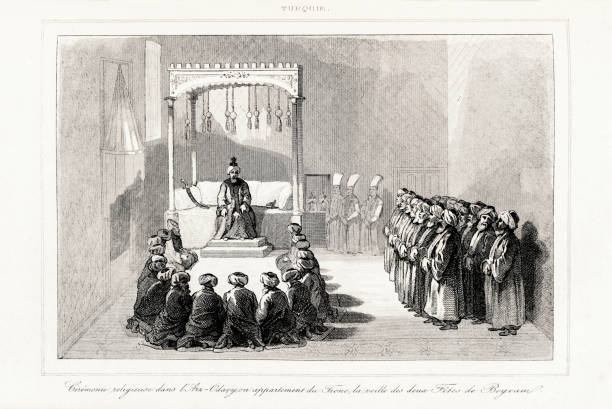
At the Heart of Ottoman Power: The Sultan's Audience The illustration titled "The Sultan's Audience" portrays an opulent court scene, likely within a palace in the Ottoman Empire. The grandeur of the setting is evident in the elaborate architectural details, with ornate carvings and luxurious textiles. Figures are depicted in various states of repose and discussion, suggesting a gathering of importance. The presence of the Sultan is implied by the central position and the attention of the attendants. The artwork communicates the richness and the ceremonial aspect of the Ottoman court life.Illustration Histoire de l'empire Ottoman, depuis les temps ancien jusqu'à nos jours. 1855 sultan ottoman empire stock illustrations

The illustration titled "The Sultan's Audience" portrays an opulent court scene, likely within a palace in the Ottoman Empire. The grandeur of the setting is evident in the elaborate architectural details, with ornate carvings and luxurious textiles. Figures are depicted in various states of repose and discussion, suggesting a gathering of importance. The presence of the Sultan is implied by the central position and the attention of the attendants. The artwork communicates the richness and the ceremonial aspect of the Ottoman court life.Illustration Histoire de l'empire Ottoman, depuis les temps ancien jusqu'à nos jours. 1855

Sultan Abdulmejid I: A Portrait of Ottoman Sovereignty The illustration titled "Abdul-Mejid" depicts a regal figure, presumably Sultan Abdulmejid I of the Ottoman Empire, portrayed riding a spirited horse. The Sultan is dressed in elaborate military regalia, with a prominent feathered headdress, indicating his high status and authority. His poised and dignified demeanor suggests leadership and command. In the background, we can see a formation of soldiers, also on horseback, reinforcing the sense of a military procession or review. The sky is filled with clouds, adding a dramatic effect to the scene and emphasizing the importance of the figure portrayed. This image captures the essence of Ottoman imperial power and the Sultan’s central role within it.Illustration de MM. Rouargue Frères - Constantinople et la Mer noire - Méry - 1855 sultan ottoman empire stock illustrations

The illustration titled "Abdul-Mejid" depicts a regal figure, presumably Sultan Abdulmejid I of the Ottoman Empire, portrayed riding a spirited horse. The Sultan is dressed in elaborate military regalia, with a prominent feathered headdress, indicating his high status and authority. His poised and dignified demeanor suggests leadership and command. In the background, we can see a formation of soldiers, also on horseback, reinforcing the sense of a military procession or review. The sky is filled with clouds, adding a dramatic effect to the scene and emphasizing the importance of the figure portrayed. This image captures the essence of Ottoman imperial power and the Sultan’s central role within it.Illustration de MM. Rouargue Frères - Constantinople et la Mer noire - Méry - 1855

Attack on Seraglio and Palace at Constantinople (1808), woodcut, 1868 The attack on seraglio and palace of Constantinople (Istanbul) for the liberation of Selim III by Bairakdar Mustafa Paşa on 28 July 1808: When Selim wanted to introduce a kind of general conscription, the Janissaries rose, dethroned and imprisoned him and brought his cousin Mustafa to power. Bairakdar Mustafa Paşa, the Pasha of Rustschuk, a staunch supporter of the Selim III reforms, gathered an army of 40,000 men and marched on the capital to reinstate the fallen sultan. However, he was late; Selim had been murdered. Selim III (1762 - 1808) was Sultan of the Ottoman Empire from 1789 to 1807. Wood engraving, published in 1868. sultan ottoman empire stock illustrations

The attack on seraglio and palace of Constantinople (Istanbul) for the liberation of Selim III by Bairakdar Mustafa Paşa on 28 July 1808: When Selim wanted to introduce a kind of general conscription, the Janissaries rose, dethroned and imprisoned him and brought his cousin Mustafa to power. Bairakdar Mustafa Paşa, the Pasha of Rustschuk, a staunch supporter of the Selim III reforms, gathered an army of 40,000 men and marched on the capital to reinstate the fallen sultan. However, he was late; Selim had been murdered. Selim III (1762 - 1808) was Sultan of the Ottoman Empire from 1789 to 1807. Wood engraving, published in 1868.

of8Next