Browse 260+ weevil drawing stock illustrations and vector graphics available royalty-free, or start a new search to explore more great stock images and vector art.

Beetles (Coleoptera), chromolithograph, published in 1889 Beetles (Coleoptera): 1) Northern dune tiger beetle  (Cicindela hybrida); 2) Sausage ground beetle (Carabus coriaceus); 3) Forest caterpillar hunter (Calosoma sycophanta); 4) Dytiscus, or "little diver" (Dytiscus latissimus); 5) Great silver water beetle (Hydrophilus piceus); 6) Rove beetle (Emus hirtus); 7) Burying beetle (Nicrophorus germanicus); 8) Hister beetle (Hister cadaverinus); 9) Bacon beetle (Dermestes lardarius); 10) European stag beetle (Lucanus cervus); 11) Minotaur beetle (Typhaeus typhoeus); 12) European rhinoceros beetle (Oryctes nasicornis); 13) Pine chafer (Polyphylla fullo); 14) Metallic Wood Boring Beetle (Euchroma gigantea); 15) Click beetle (Selatosomus aeneus); 16) Glowworm (Lampyris noctiluca); 17) European beewolf (Philanthus triangulum); 18) Spanish fly (Lytta vesicatoria); 19) European oil beetle (Meloe proscarabaeus); 20) South American palm weevil (Rhynchophorus palmarum); 21) Black pine bark beetle (Hylastes ater); 22) European spruce bark beetle (Ips typographus); 23) Great capricorn beetle (Cerambyx cerdo); 24) Musk beetle (Aromia moschata); 25) Yellow-bowed longhorn beetle (Plagionotus arcuatus); 26) Red poplar leaf beetle (Chrysomela populi). Chromolithograph, published in 1889. weevil drawing stock illustrations
Beetles (Coleoptera), chromolithograph, published in 1889 Beetles (Coleoptera): 1) Northern dune tiger beetle (Cicindela hybrida); 2) Sausage ground beetle (Carabus coriaceus); 3) Forest caterpillar hunter (Calosoma sycophanta); 4) Dytiscus, or "little diver" (Dytiscus latissimus); 5) Great silver water beetle (Hydrophilus piceus); 6) Rove beetle (Emus hirtus); 7) Burying beetle (Nicrophorus germanicus); 8) Hister beetle (Hister cadaverinus); 9) Bacon beetle (Dermestes lardarius); 10) European stag beetle (Lucanus cervus); 11) Minotaur beetle (Typhaeus typhoeus); 12) European rhinoceros beetle (Oryctes nasicornis); 13) Pine chafer (Polyphylla fullo); 14) Metallic Wood Boring Beetle (Euchroma gigantea); 15) Click beetle (Selatosomus aeneus); 16) Glowworm (Lampyris noctiluca); 17) European beewolf (Philanthus triangulum); 18) Spanish fly (Lytta vesicatoria); 19) European oil beetle (Meloe proscarabaeus); 20) South American palm weevil (Rhynchophorus palmarum); 21) Black pine bark beetle (Hylastes ater); 22) European spruce bark beetle (Ips typographus); 23) Great capricorn beetle (Cerambyx cerdo); 24) Musk beetle (Aromia moschata); 25) Yellow-bowed longhorn beetle (Plagionotus arcuatus); 26) Red poplar leaf beetle (Chrysomela populi). Chromolithograph, published in 1889. weevil drawing stock illustrations

Beetles (Coleoptera): 1) Northern dune tiger beetle (Cicindela hybrida); 2) Sausage ground beetle (Carabus coriaceus); 3) Forest caterpillar hunter (Calosoma sycophanta); 4) Dytiscus, or "little diver" (Dytiscus latissimus); 5) Great silver water beetle (Hydrophilus piceus); 6) Rove beetle (Emus hirtus); 7) Burying beetle (Nicrophorus germanicus); 8) Hister beetle (Hister cadaverinus); 9) Bacon beetle (Dermestes lardarius); 10) European stag beetle (Lucanus cervus); 11) Minotaur beetle (Typhaeus typhoeus); 12) European rhinoceros beetle (Oryctes nasicornis); 13) Pine chafer (Polyphylla fullo); 14) Metallic Wood Boring Beetle (Euchroma gigantea); 15) Click beetle (Selatosomus aeneus); 16) Glowworm (Lampyris noctiluca); 17) European beewolf (Philanthus triangulum); 18) Spanish fly (Lytta vesicatoria); 19) European oil beetle (Meloe proscarabaeus); 20) South American palm weevil (Rhynchophorus palmarum); 21) Black pine bark beetle (Hylastes ater); 22) European spruce bark beetle (Ips typographus); 23) Great capricorn beetle (Cerambyx cerdo); 24) Musk beetle (Aromia moschata); 25) Yellow-bowed longhorn beetle (Plagionotus arcuatus); 26) Red poplar leaf beetle (Chrysomela populi). Chromolithograph, published in 1889.

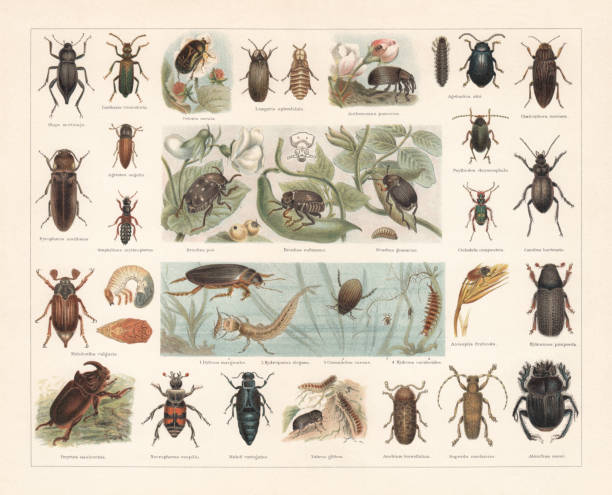
Beetles, chromolithograph, published in 1897 Beetles, 1st row: Darkling beetle (Blaps mortisaga); Spanish fly (Lytta vesicatoria, or Cantharis vesicatria); Rose chafer (Cetonia aurata); Glow worm (Lampyris splendidula), male (left) and female (right); Apple blossom weevil (Anthonomus pomorum); Alder leaf beetle (Agelastica alni); Flatheaded pine borer (Chalcophora mariana). 2nd row: Headlight Elater (Pyrophorus noctilucus); Lined Click Beetle (Agriotes lineatus, or Agriotes segetis); Staphylinus erythropterus; Pea weevil (Bruchus pisorum, or Bruchus pisi); Bean weevil (Acanthoscelides obtectus, or Bruchus rufimagnus) with magnified head (top); Seed beetle (Bruchus atomarius, or Bruchus granarius); Cabbage-stem flea beetle (Psylliodes chrysocephala); Green tiger beetle (Cicindela campestris); Carabus hortensis. 3rd row: Cockchafer, or May bug (Melontha vulgaris) with larva and pupa (right); Dytiscus marginalis with larva (1); Hydroporus elegans (2); Peltodytes caesus, or Cnemidotus caesus (3); Hydrous caraboides (larva, 4) Anisoplia villosa (or Anisoplia fruticola); Bark beetle (Hylesinus piniperda). 4th row: European rhinoceros beetle (Oryctes nasicornis); Burying beetle (Nicrophorus vespillo, or Necrophorus vespillo); European oil beetle (Meloe variegatus); Zabrus tenebrioides (or Zabrus gibbus); Death Watch Beetle (Xestobium rufovillosum, or Anobium tessellatum); Longhorn beetle (Saperda carcharias); Sacred scarab (Scarabaeus sacer, or Ateuchus sacer). Chromolithograph, published in 1897. weevil drawing stock illustrations

Beetles, 1st row: Darkling beetle (Blaps mortisaga); Spanish fly (Lytta vesicatoria, or Cantharis vesicatria); Rose chafer (Cetonia aurata); Glow worm (Lampyris splendidula), male (left) and female (right); Apple blossom weevil (Anthonomus pomorum); Alder leaf beetle (Agelastica alni); Flatheaded pine borer (Chalcophora mariana). 2nd row: Headlight Elater (Pyrophorus noctilucus); Lined Click Beetle (Agriotes lineatus, or Agriotes segetis); Staphylinus erythropterus; Pea weevil (Bruchus pisorum, or Bruchus pisi); Bean weevil (Acanthoscelides obtectus, or Bruchus rufimagnus) with magnified head (top); Seed beetle (Bruchus atomarius, or Bruchus granarius); Cabbage-stem flea beetle (Psylliodes chrysocephala); Green tiger beetle (Cicindela campestris); Carabus hortensis. 3rd row: Cockchafer, or May bug (Melontha vulgaris) with larva and pupa (right); Dytiscus marginalis with larva (1); Hydroporus elegans (2); Peltodytes caesus, or Cnemidotus caesus (3); Hydrous caraboides (larva, 4) Anisoplia villosa (or Anisoplia fruticola); Bark beetle (Hylesinus piniperda). 4th row: European rhinoceros beetle (Oryctes nasicornis); Burying beetle (Nicrophorus vespillo, or Necrophorus vespillo); European oil beetle (Meloe variegatus); Zabrus tenebrioides (or Zabrus gibbus); Death Watch Beetle (Xestobium rufovillosum, or Anobium tessellatum); Longhorn beetle (Saperda carcharias); Sacred scarab (Scarabaeus sacer, or Ateuchus sacer). Chromolithograph, published in 1897.

Different beetle insects isolated on white 1898 The harlequin beetle (Acrocinus longimanus) is a tropical longhorned beetle native from southern Mexico to Uruguay. - Pyrochroa is a genus of cardinal beetle in the family Pyrochroidae. - Cyrtotrachelus is a genus of beetles belonging to the family CurculionidaeOriginal edition from my own archivesSource : Brockhaus 1898 weevil drawing stock illustrations

The harlequin beetle (Acrocinus longimanus) is a tropical longhorned beetle native from southern Mexico to Uruguay. - Pyrochroa is a genus of cardinal beetle in the family Pyrochroidae. - Cyrtotrachelus is a genus of beetles belonging to the family CurculionidaeOriginal edition from my own archivesSource : Brockhaus 1898

Animal homes, wood engravings, published in 1897 Animal homes, left side: 1) Nest of the squirrel (Sciurus vulgaris), Nest of the orangutan (Pongo pygmaeus); 3) Beaver (Castor) activities; 4) Nest of the harvest mouse (Micromys minutus); 5) Nest (a) and sleeping nest (b) of the dormouse; 6) Den of the mole (Talpa europaea); 7) Badger's burrow; 8) Rabbit burrow. Right side: 1-2) Wasp structure of Scaria variegata (1) and Trypoxylon aurifrons (2); 3) Land crab (Pachylomerus nidulans); 4 + 9) Bagmoth (Psychidae); 5) Trapdoor spider (Cteniza sauvagesi); 6) Wasp (Vespa media); 7) Hornet; 8) Tooth-nosed snout weevil; 10) Doodlebug (or antlion); 11) Larva of the tiger beetle (Cicindelidae); 12) Anthill (Tapinoma); 13) Aphid pavilion, built by ants; 14) Termitarium; 15) Tube worms; 16 Stickleback nest; 17) Nest of the file shell (Limidae); 18) Water spider (Argyroneta aquatica); 19) Caddisfly structure (Phryganeidae). Wood engravings, published in 1897. weevil drawing stock illustrations

Animal homes, left side: 1) Nest of the squirrel (Sciurus vulgaris), Nest of the orangutan (Pongo pygmaeus); 3) Beaver (Castor) activities; 4) Nest of the harvest mouse (Micromys minutus); 5) Nest (a) and sleeping nest (b) of the dormouse; 6) Den of the mole (Talpa europaea); 7) Badger's burrow; 8) Rabbit burrow. Right side: 1-2) Wasp structure of Scaria variegata (1) and Trypoxylon aurifrons (2); 3) Land crab (Pachylomerus nidulans); 4 + 9) Bagmoth (Psychidae); 5) Trapdoor spider (Cteniza sauvagesi); 6) Wasp (Vespa media); 7) Hornet; 8) Tooth-nosed snout weevil; 10) Doodlebug (or antlion); 11) Larva of the tiger beetle (Cicindelidae); 12) Anthill (Tapinoma); 13) Aphid pavilion, built by ants; 14) Termitarium; 15) Tube worms; 16 Stickleback nest; 17) Nest of the file shell (Limidae); 18) Water spider (Argyroneta aquatica); 19) Caddisfly structure (Phryganeidae). Wood engravings, published in 1897.

of5Next