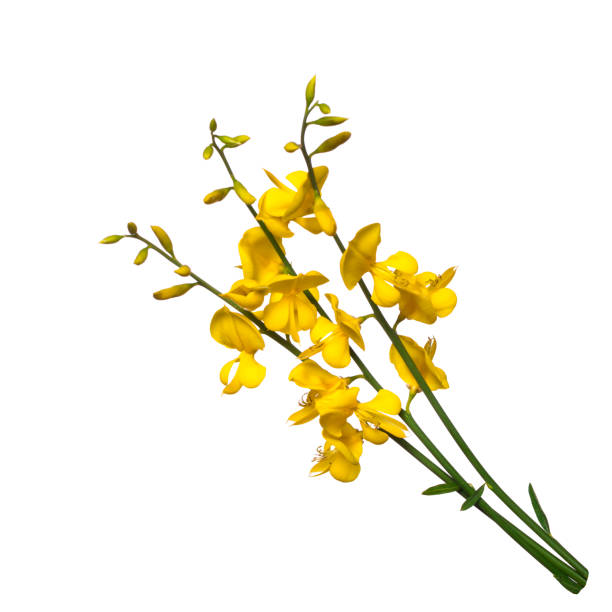
386 Retama Images and Stock Photos

View retama videos

Browse 380+ retama stock photos and images available, or search for broom flower or broom plant to find more great stock photos and pictures.

Our creative library is free of AI-generated contentChoose your visuals with confidence knowing our creative library is free from AI-generated content, so your searches only return safe, high-quality visuals you can trust.
Parkinsonia aculeata Retama-Blooming grasses with yellow flowers Parkinsonia aculeata may be a spiny shrub or a small tree. It grows 2 to 8 m (6.6 to 26.2 ft) high, with a maximum height of 10 metres (33 ft). Palo verde may have single or multiple stems and many branches with pendulous leaves. The leaves and stems are hairless. The leaves are alternate and pennate (15 to 20 cm long). The flattened petiole is edged by two rows of 25"u201330 tiny oval leaflets; the leaflets are soon deciduous in dry weather (and during the winter in some areas) leaving the green petioles and branches to photosynthesize."n"nThe branches grow double or triple sharp spines 7"u201312 mm (0.28"u20130.47 in) long at the axils of the leaves. The flowers are yellow- orange and fragrant, 20 mm (0.79 in) in diameter, growing from a long slender stalk in groups of eight to ten. They have five sepals and five petals, four of them clearer and rhomboid ovate, the fifth elongated, with a warmer yellow and purple spots at the base. The flowering period is in the middle months of spring (March"u2013April or September"u2013October). The flowers are pollinated by bees. The fruit is a seedpod, leathery in appearance, light brown when mature.Laguna Atascosa National Wildlife Refuge in south Texas retama stock pictures, royalty-free photos & images

Parkinsonia aculeata may be a spiny shrub or a small tree. It grows 2 to 8 m (6.6 to 26.2 ft) high, with a maximum height of 10 metres (33 ft). Palo verde may have single or multiple stems and many branches with pendulous leaves. The leaves and stems are hairless. The leaves are alternate and pennate (15 to 20 cm long). The flattened petiole is edged by two rows of 25"u201330 tiny oval leaflets; the leaflets are soon deciduous in dry weather (and during the winter in some areas) leaving the green petioles and branches to photosynthesize."n"nThe branches grow double or triple sharp spines 7"u201312 mm (0.28"u20130.47 in) long at the axils of the leaves. The flowers are yellow- orange and fragrant, 20 mm (0.79 in) in diameter, growing from a long slender stalk in groups of eight to ten. They have five sepals and five petals, four of them clearer and rhomboid ovate, the fifth elongated, with a warmer yellow and purple spots at the base. The flowering period is in the middle months of spring (March"u2013April or September"u2013October). The flowers are pollinated by bees. The fruit is a seedpod, leathery in appearance, light brown when mature.Laguna Atascosa National Wildlife Refuge in south Texas

The yellow broom (Retama sphaerocarpa) The yellow broom (Retama sphaerocarpa) is a shrub of the Fabaceae family, native to northwest Africa and the Iberian Peninsula. It is very common in Spain, especially in Aragon, La Mancha, Extremadura, and Andalusia, where it forms extensive thickets. It can reach up to 3 meters in height. Its branches are grayish and highly branched. Its flowers are small and yellow, grouped in clusters. It is a xerophytic plant, tolerant of extreme cold and heat. retama stock pictures, royalty-free photos & images

The yellow broom (Retama sphaerocarpa) is a shrub of the Fabaceae family, native to northwest Africa and the Iberian Peninsula. It is very common in Spain, especially in Aragon, La Mancha, Extremadura, and Andalusia, where it forms extensive thickets. It can reach up to 3 meters in height. Its branches are grayish and highly branched. Its flowers are small and yellow, grouped in clusters. It is a xerophytic plant, tolerant of extreme cold and heat.

The yellow broom (Retama sphaerocarpa) The yellow broom (Retama sphaerocarpa) is a shrub of the Fabaceae family, native to northwest Africa and the Iberian Peninsula. It is very common in Spain, especially in Aragon, La Mancha, Extremadura, and Andalusia, where it forms extensive thickets. It can reach up to 3 meters in height. Its branches are grayish and highly branched. Its flowers are small and yellow, grouped in clusters. It is a xerophytic plant, tolerant of extreme cold and heat. retama stock pictures, royalty-free photos & images

The yellow broom (Retama sphaerocarpa) is a shrub of the Fabaceae family, native to northwest Africa and the Iberian Peninsula. It is very common in Spain, especially in Aragon, La Mancha, Extremadura, and Andalusia, where it forms extensive thickets. It can reach up to 3 meters in height. Its branches are grayish and highly branched. Its flowers are small and yellow, grouped in clusters. It is a xerophytic plant, tolerant of extreme cold and heat.

Parkinsonia aculeata Retama-Blooming grasses with yellow flowers Parkinsonia aculeata may be a spiny shrub or a small tree. It grows 2 to 8 m (6.6 to 26.2 ft) high, with a maximum height of 10 metres (33 ft). Palo verde may have single or multiple stems and many branches with pendulous leaves. The leaves and stems are hairless. The leaves are alternate and pennate (15 to 20 cm long). The flattened petiole is edged by two rows of 25"u201330 tiny oval leaflets; the leaflets are soon deciduous in dry weather (and during the winter in some areas) leaving the green petioles and branches to photosynthesize."n"nThe branches grow double or triple sharp spines 7"u201312 mm (0.28"u20130.47 in) long at the axils of the leaves. The flowers are yellow- orange and fragrant, 20 mm (0.79 in) in diameter, growing from a long slender stalk in groups of eight to ten. They have five sepals and five petals, four of them clearer and rhomboid ovate, the fifth elongated, with a warmer yellow and purple spots at the base. The flowering period is in the middle months of spring (March"u2013April or September"u2013October). The flowers are pollinated by bees. The fruit is a seedpod, leathery in appearance, light brown when mature.Laguna Atascosa National Wildlife Refuge in south Texas retama stock pictures, royalty-free photos & images

Parkinsonia aculeata may be a spiny shrub or a small tree. It grows 2 to 8 m (6.6 to 26.2 ft) high, with a maximum height of 10 metres (33 ft). Palo verde may have single or multiple stems and many branches with pendulous leaves. The leaves and stems are hairless. The leaves are alternate and pennate (15 to 20 cm long). The flattened petiole is edged by two rows of 25"u201330 tiny oval leaflets; the leaflets are soon deciduous in dry weather (and during the winter in some areas) leaving the green petioles and branches to photosynthesize."n"nThe branches grow double or triple sharp spines 7"u201312 mm (0.28"u20130.47 in) long at the axils of the leaves. The flowers are yellow- orange and fragrant, 20 mm (0.79 in) in diameter, growing from a long slender stalk in groups of eight to ten. They have five sepals and five petals, four of them clearer and rhomboid ovate, the fifth elongated, with a warmer yellow and purple spots at the base. The flowering period is in the middle months of spring (March"u2013April or September"u2013October). The flowers are pollinated by bees. The fruit is a seedpod, leathery in appearance, light brown when mature.Laguna Atascosa National Wildlife Refuge in south Texas

of7Next
Take any image from "not quite" to "just right"See how you can modify existing images — or generate entirely new ones — to your exact needs.
Discover Unlimited AI