
Yanartas or flaming stone-geographical feature near Olympos valley-dozens of small constantly burning fires from vents in rocks-inspiration for the fire breathing Chimaera monster. Çirali-Lycia-Turkey
Browse 60+ vulcan mythology photos stock photos and images available, or start a new search to explore more stock photos and images.
Yanartas or flaming stone-geographical feature near Olympos valley-dozens of small constantly burning fires from vents in rocks-inspiration for the fire breathing Chimaera monster. Çirali-Lycia-Turkey
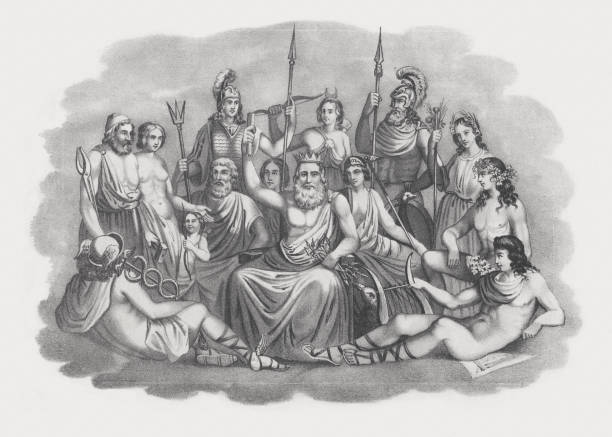
The gods of Greek Mythology. Lithograph, published in 1852.

Hephaestus - the Greek god of blacksmiths, craftsmen, artisans, sculptors, metals, metallurgy, fire and volcanoes. Woodcut engraving, published in 1878.

The Forge of Vulcan. Wood engraving after an ancient motif, published in 1883.

Vulcan forging Prometheus to the rock. Oceanids implore for the liberation of Prometheus. Szene from the Greek Mythology. Woodcut engraving from the the book "Der Olymp oder die Mythologie der Griechen und Römer (The Olympus or the Mythology of the Greeks and Romans)", published by A.H. Petiscus in C.F. Amelang's Verlag, Leipzig (1878, 18th edition)

NYC, NY USA Mar 9, 2013: From left to right, Vulcan, Mercury, and Minerva are depicted in this close-up of this iconic and monumental sculpture group at Grand Central Terminal, E. 42nd Street, in Midtown Manhattan. The sculpture group, largest in the world at the time of its installation in 1913, is by French sculptor Jules Felix Coutan (1848 - 1939.) The 13-foot diameter clock face is the largest piece of Tiffany glass ever made.

West Saint Paul Days parade West Saint Paul, MN/USA – May 19, 2018: Member of Saint Paul Winter Carnival Vulcan Krewe paints face of young boy during annual West Saint Paul Days parade.

The ruin and temple of Hephaestus in Athens. The Temple of Hephaestus is the best-preserved ancient Greek temple, and is located at the Agora of Athens, Greece.

GREECE - CIRCA 1986: A stamp printed in Greece from the "Gods of Olympus" issue shows god Hephaestus.

candles on the black background

"The Temple of Hephaestus, also known as the Hephaisteion or earlier as the Theseion, is a well-preserved Greek temple; it remains standing largely as built. It is a Doric peripteral temple, and is located at the north-west side of the Agora of Athens, on top of the Agoraios Kolonos hill. From the 7th century until 1834, it served as the Greek Orthodox church of St. George Akamates."

The old temple of the god Greek god Hephaestus

Athens, Greece - June 10, 2016: Temple of Herphaesus in the Ancient Agora. Photo taken during the day and contains some tourists visiting the attraction.

Temple of Hephaestus in the Ancient Agora of Athens, Greece

Athens, Greece - June 10, 2016: Temple of Herphaesus in the Ancient Agora. Photo taken during the day and contains some tourists visiting the attraction.

This magnificent Greek temple is in the Agora area within the Acropolis ruins.

This magnificent Greek temple is in the Agora area within the Acropolis ruins.

Hephaestus Temple, Ancient Agora, Athens, Greece

Temple of Hephaestus in Ancient Agora against cloudy sky, Athens, Greece, light HDR

The Gallic Vulcan, after a Celtic Monument discovered beneth the Choir of Notre Dame, Paris

“I’m Not Hercules!” - Vulcan at Grand Central Terminal. The gentleman depicted on the left side of the “Glory of Commerce” sculpture group at Grand Central Terminal is almost universally described as Hercules. But he has no large wooden club, no lion’s-head cloak, and is decidedly too scrawny to be Hercules. Instead, note that he is holding a hammer in his right hand, a big forging hammer. And what do we see behind his right calf but an anvil! So this guy is some sort of blacksmith. And who, in classical mythology, is a blacksmith? That would be Vulcan, the Roman equivalent of the Greek god Hephaestus, who was the Olympian in charge of, inter alia, technology, blacksmiths, craftsmen, artisans, sculptors, metals, and metallurgy. Notice also that on his side of the sculpture group there are other objects that make sense in the context of Hephaestus/Vulcan. The anchor and gear, symbols of commerce and industry of the time, are both items that require casting, forging, machining, etc all technologies that are within the ambit of Vulcans patronage. The sickle in his left hand ties Vulcan to the stalks of wheat, representing midwest grain arriving at Grand Central via Commodore Vanderbilt’s New York Central Railroad.

The Temple of Hephaestus is the best-preserved ancient Greek temple, and is located at the Agora of Athens, Greece.

A Greek temple. With a blue sky on the background. Some nice Columns, taken under a low angle.

The Temple of Hephaestus is the best-preserved ancient Greek temple, and is located at the Agora of Athens, Greece.

Vintage engraving showing the ancient Roman God Vulcan,1864

Column detail of the magnificent Greek temple is in the Agora area within the Acropolis ruins

This magnificent Greek temple is in the Agora area within the Acropolis ruins

The perfection of ancient greek architecture


